 We got pregnant in July 2021 and what seemed to be a dream pregnancy with minimal symptoms all changed when I saw my midwife at 30 weeks pregnant. It was during this appointment I knew something was wrong when it was found I was measuring the equivalent of 39 weeks. I was diagnosed with severe polyhydramnios where my amniotic fluid index reached a high of 48 cm, but I was reassured the scans were all normal and it was assumed my polhydramnios was benign. Call it a mother’s instinct but I knew something serious was wrong, so much so I cancelled my baby shower. The following six weeks were filled with anxiety, googling every possible cause, scans and multiple trips to hospital. It was during this time I had a suspected rupture of membranes and was scheduled for an induction at 37 weeks. Unfortunately my body had other plans, and as I reached a size equivalent of over 53 weeks pregnant, an infection was brewing and the baby was having a good swim around ending in a breech position with the umbilical cord at risk of prolapsing. The decision was made to have an urgent C-Section which was scheduled for the next day. Thursday the 3rd of March 2022 approached and as I eagerly waited to be called to the delivery suite the midwife assessed me and got me all prepped. However there were concerns that my contractions (which were no different to how they had been for the past two months) were too strong and feared I was in active labour. On examination it was determined I was not in labour and it was feared I was going septic, it was at this point that the C-Section was to go ahead as an emergency.
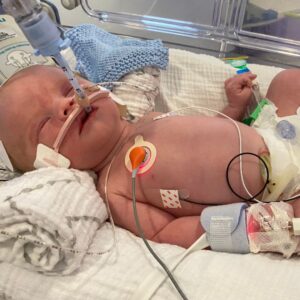
As I lay there knowing my life was about to change, eager and filled with excitement, I heard the theatre staff saying this was the worst case of polyhydramnios they had ever seen as they suctioned over 4 litres of fluid I could feel my stomach deflate like a balloon. This was followed by a little cry and the Anaesthetist saying here comes your baby. As I looked over I saw the midwife run past with a lifeless baby in her arms and say not yet. Next came the sound I will never forget and one I know all too well from being a coronary care nurse, the arrest bell. People came running in saying mother or baby, and as I heard baby my heart sunk. Half an hour or so passed before I was finally able to hold my little baby boy intubated and asleep before he was then taken off to Neonatal intensive care unit (NICU). A few hours passed and we were finally reunited with our little Theo Koa, he lay in the incubator Intubated with EEG monitoring, an NG tube, ECG monitoring, Co2 monitor, Cannulas, BP Cuff and Sa02 monitoring.
The following day and a few investigations in we met with the Drs who explained they were concerned that Theo’s head was too large and hadn’t formed correctly, he was not breathing for himself, and was making very little attempt to move his limbs and cry. We came away from that meeting with a very bleak picture and little hope of Theo ever making it home. We delayed telling family and friends that Theo had been born in fear we would be following it with a different message shortly after, which meant we didn’t actually ever celebrate the birth of Theo. A few days later Theo had an urgent MRI of his head which showed Theo’s head had formed correctly and appeared structurally normal. The following weeks were a blur, Theo had multiple investigations, seen by various teams of DRs and multiple potential diagnosis were given. It wasn’t until at 3 weeks Theo underwent a sleep study which indicated a condition called Congenital Central Hypoventilation Syndrome (CCHS). This was confirmed the following week with Genetic testing that found Theo had a mutation of the PHOX2B gene of 20/27. This surprised even the respiratory consultant who informed us there are only approximately 1000-1500 individuals with this condition in the world.
From here, our Journey entered a new chapter. At five weeks old Theo had a tracheostomy inserted and our training on all his medical equipment began. I will never forget the feeling of a NICU nurse telling me I needed to do his tracheostomy ties with her before I picked him up for cuddles. At this point I broke down and said I just want to be his mum and not feel like a nurse, I haven’t even bathed my baby yet but yet I’ve done medical interventions. Theo spent 7 weeks in NICU before being transferred to a ward. It was from here onwards we began life with CCHS and began to see the implications the condition has on daily activities and the logistics of working around the ventilator and monitoring equipment.
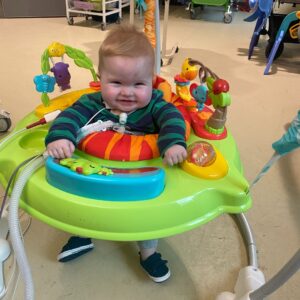
A major step in our CCHS journey was when we trialed Theo off the ventilator and on his Swedish nose (humidifier cap) for the first time, initially we trialed five minutes which felt like an eternity as we watched Theo’s breathing, his oxygen levels, and tried to keep him alert. Over time we have been able to increase the time off the ventilator and have been lucky enough that Theo tolerates long periods. Having said this, in times when Theo is unwell or concentrating on chewing a teething toy he requires full assistance from the ventilator, and is fully dependent on the ventilator when asleep. Theo can also become very distressed and breath hold resulting in losing consciousness and being reliant on the ventilator to bring him back, therefore he always needs constant supervision.
Theo had his first bath whilst connected to the ventilator, which proved a little difficult but none the less he absolutely loved it. We began to introduce breast and bottle feeding with lots of support from the speech and language therapist, with eventually the NG (feeding tube) being removed at 3 months old. We have begun weaning but this has proved a slow process as Theo occasionally appears to aspirate and has difficulty in co-ordinating the swallowing and breathing, resulting in lots of desaturations and occasionally requiring the ventilator to assist with breathing. Life with a tracheostomy brings its own challenges and involves daily dressing changes and monthly tube changes, both of which Theo can find distressing, which we try and minimise with a bit of cocomelon and thomas the tank engine to distract him! As Theo grows there is now more of a leak around his tracheostomy which has allowed Theo to make sound. I will never forget the first time I heard him cry following the tracheostomy, it filled me with so much emotion and I sat there crying with him in a bitter sweet moment. I can’t wait until the day we finally hear Theo’s cheeky little laugh and to hear him say his first words.
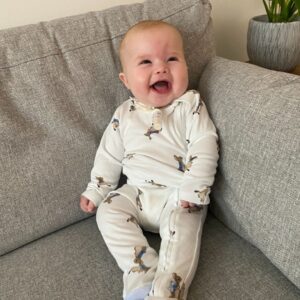
At three months old Theo got to go outside for the first time and meet all his family. He made it home at 4 months for a few hours then we gradually increased our time with Theo finally having his first night at 6 months old. At 11 months Theo is still an inpatient in hospital and the ward staff have become an extension of our family as they’ve watched Theo grow in to the most lovable and smiley little boy.
The past 11 months have been extremely challenging as we find our feet and settle in to our new normal and how life will be. Our family have been trained up in tracheostomy care and caring for Theo with his ventilator and monitoring machines. Now we eagerly await a 7 night care package which will ensure Theo is kept safe and monitored 24/7. This was never the story we imagined, but it’s our story and we are are so unbelievably lucky to have Theo, who radiates happiness and fills so many peoples days with smiles as he pulls his cheeky little grin.
Catherine
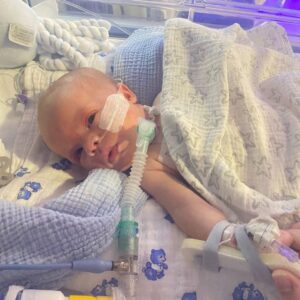


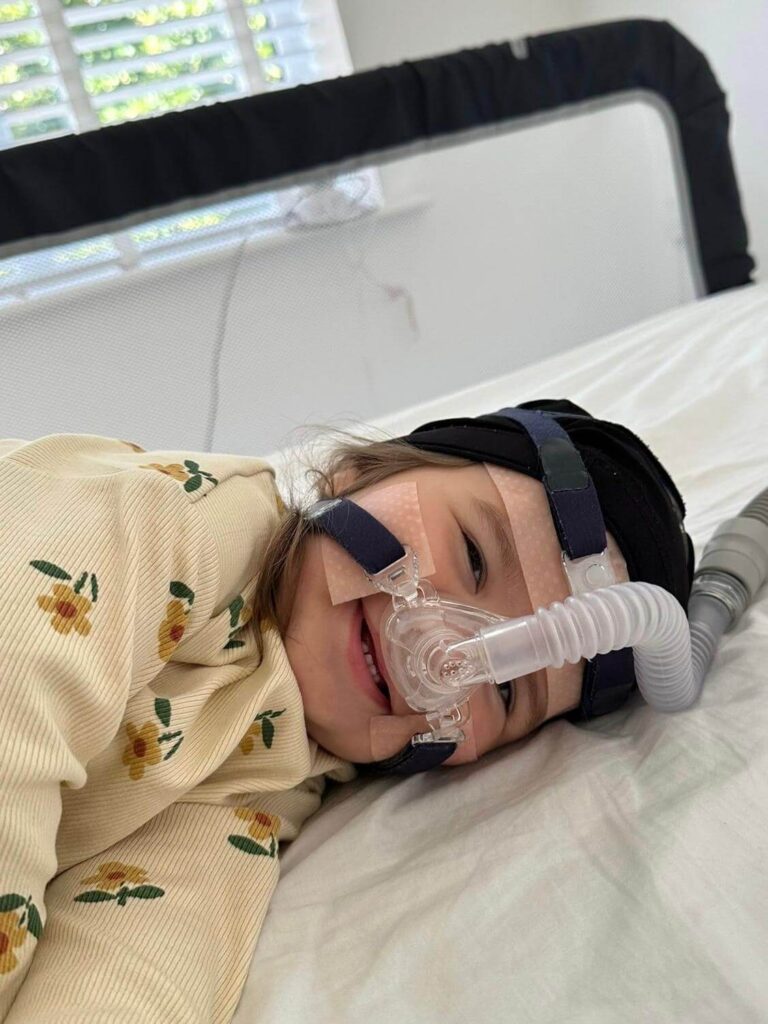
At just six weeks old, Tiger-Lily needed a tracheostomy after doctors discovered she had Congenital Central Hypoventilation Syndrome (CCHS). This rare condition means Tiger-Lily stops breathing as soon as she falls asleep and needs constant supervision. For Mum, Vicky, and Dad, Ricky, this was the start of a journey they never expected to go on.
‘It was touch and go from the moment Tiger-Lily was born.’
Minutes after Tiger-Lily was born, she turned blue and was whisked away. I still remember the silence. She was surrounded by doctors, and no one could tell us what was going on. Her Dad and I were in complete shock. The next time we saw our daughter she was in intensive care with wires everywhere and a tube to help her breathe.
‘I was fearful of everything.’
We were desperate to get home, but that’s when the real hard work started. Suddenly, we were on our own with a baby on a ventilator every second of the day, needing loads of equipment and constant monitoring to keep her alive.
I was determined to look after Tiger-Lily on my own. Yet in the weeks that followed my world shrank. I went from being a busy hairdresser to feeling like I had a new career as a nurse and realised I hadn’t left the house for a whole month.
Thankfully, Tiger-Lily only needs her ventilator at night now and there’s nothing she doesn’t do. I take her horse riding, we go to festivals and she loves playing with friends. There is still a lot to think about and sometimes we do end up in hospital as her tracheostomy makes her vulnerable to infections. But every year she gets a bit stronger.
Vicky


Mila was born on 7 March 2023 via caesarean section. What we thought would be the happiest moment of our lives quickly shifted into something none of us were prepared for. Soon after birth, she was moved to the neonatal intensive care unit (NICU) because her temperature and oxygen levels were falling. In the NICU a nurse (and colleague) put a probe on her foot and noticed she wasn’t breathing properly when she slept and she was placed in an oxygenated incubator. If it wasn’t for my work in that hospital, we would have lost Mila there and then.
Within the following hours Mila’s stomach started to show distension (swelling) and the next day she was transferred by ambulance to Great Ormond Street Hospital.
At just ten days old, Mila was given a confirmed diagnosis of Hirschsprung’s Disease and was given an ileostomy. During the recovery process, doctors had also picked up on irregularities in her breathing and at 12 weeks old, genetic testing confirmed CCHS – Central Congenital Hypoventilation Syndrome. In a weird twist of fate, Mila’s Hirschsprung’s diagnosis saved her life by triggering the additional level of supervision she needed.
We would have never of thought that when Mila falls asleep, her body would forget to breathe. What is meant to be such a normal part of life is now one of the things we fear the most. She now relies on a BiPAP ventilator every night and must be cared for by someone trained to respond if she stops breathing.
If that wasn’t enough for one tiny human, during her first year Mila was also diagnosed with hyperinsulinism, which causes dangerous drops in blood sugar due to abnormally high levels of insulin in the blood. She spent many months tube-fed and was readmitted to hospital several times. She later had more bowel surgery to remove damaged sections of intestine following two prolapses of her stoma and then finally reversing it at 18 months old.
Mila spent a total of 14 months in hospital before we were finally able to take her home for the long term. Those months were filled with wires, machines, and sleepless nights – but she still found ways to show us who she was. She laughed, played peekaboo with her blanket, and managed to charm just about every nurse she met.
From early on, it was clear Mila wasn’t going to let her medical needs define her.
She’s now two years old and full of curiosity and mischief and is thriving in a nursery environment. She wears her BiPAP mask for every nap and night’s sleep, and we manage her bowel condition and blood sugars carefully through diet. She’s already learning to take part in her care – helping with her gastrostomy and even trying to put her mask on herself.
Mila has faced more in two years than most do in a lifetime. Yet every laugh, every step forward, every moment she surprises us is a reminder of her strength. She’s not just coping – she’s living. And we couldn’t be prouder.
I now serve on the advisory board of Keep Me Breathing. Like every parent of a child with CCHS, I hope that one day Mila will sleep without machines keeping her alive.
Whatever it takes.
Mete

Get in touch and share your story – steph@keepmebreathing.com


