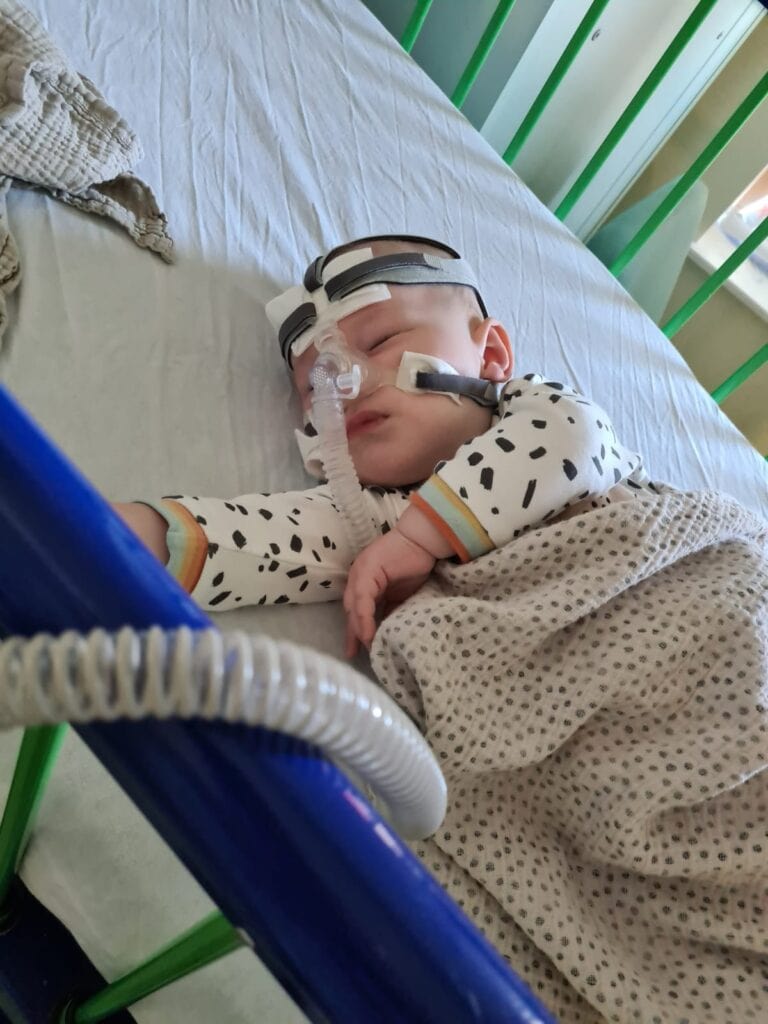
CCHS. A newborn, diagnosis, specialists and new treatments.

Do you have a newborn with CCHS or a recent CCHS diagnosis in your family? 

A newborn with CCHS? Or a new CCHS diagnosis? What to do first

  • First, breathe. If you’re reading this in a hospital, days into a diagnosis you’d never heard of a week ago, remember this: children with CCHS grow up. They go to school, they play, they laugh, they live full lives. The machines that feel terrifying today become quiet background to an ordinary childhood. It will feel horrendous, and it is. But the first months are the worst.
  • CCHS means your child doesn’t automatically control their breathing, especially in sleep. It’s caused by a change in one gene, PHOX2B. It’s rare, lifelong and life threatening. But it is manageable.
  • The most useful thing to understand right now is that you have choices. Breathing support varies by country and even by hospital, tracheostomy, mask (non-invasive) ventilation, or diaphragm pacing, each with real advantages and real trade-offs. There’s no single right answer; there’s the right answer for your child and your family. You should be offered all the options and given space to decide.
  • But you won’t always be offered this. CCHS is rare, to the point doctors may never come across it in their entire career, and even ones who do, unless they are an active researcher and specialist (like at Great Ormond Street Hospital), you may only be offered one type of treatment when in fact there are 3.
  • The one thing no parent should do is make this decision alone, in the dark. That’s what we’re here for. Keep Me Breathing was founded by parents of children with CCHS.
  •  Speak to one of the team today by emailing james@keepmebreathing.com

Specialists by Country

As said, having a newborn with CCHS is tough, and CCHS is rare enough that most doctors will never see a single case. Being cared for by a team that genuinely knows the condition changes everything, how your child is ventilated, how the associated risks are screened, how confident you feel walking into every appointment.

Care pathways differ from country to country, county to county in the UK and state to state in the US. In some, mask ventilation is a first choice, in others children move from a tracheostomy to mask ventilation between five and ten years old; in others, the route is toward diaphragm pacing, in others a tracheostomy until teenage years is recommended. Knowing which recognised CCHS centre or specialist is nearest to you, and what good care looks like, lets you ask the right questions and advocate for your child with confidence.

We stay in close contact with the right CCHS clinicians, specialist centres and family associations across the US, UK, Europe, the beyond. Email us on james@keepmebreathing.com for more support here.

New Treatments for CCHS

For decades, the answer to CCHS has been a machine that breathes for your child, meaning reliance on bulky equipment, electricity and having the right clinican. We don’t accept that as the end of the story and we’re working, urgently, to change it.

Keep Me Breathing has already developed patented technology and is driving the development of a fully implantable phrenic nerve pacer: a biofeedback diaphragm pacing system designed to sense your child’s breathing needs and adjust support automatically, with the goal of reducing, and one day removing, the reliance on external ventilation.

As our founders put it: the technology to make a world of difference to the lives of children with CCHS is there, the investment is not. We’re changing that.

We want to be honest with you: this work is in active research and development and is not yet an available treatment. But it is real, it is moving, and we are closer than anyone else in the world at delivering the worlds first treatment made for CCHS. Families are at the centre of it. Email james@keepmebreathing.com to hear more including our recent press coverage on VENTO, our patented technology developed which has recently been validated by The Extreme Environments Lab at Portsmouth University

The Children.

Casper (Mask Ventilated) and Beau (Tracheostomy Ventilated)

The most beautiful Keep Me Breathing Ambassadors!